
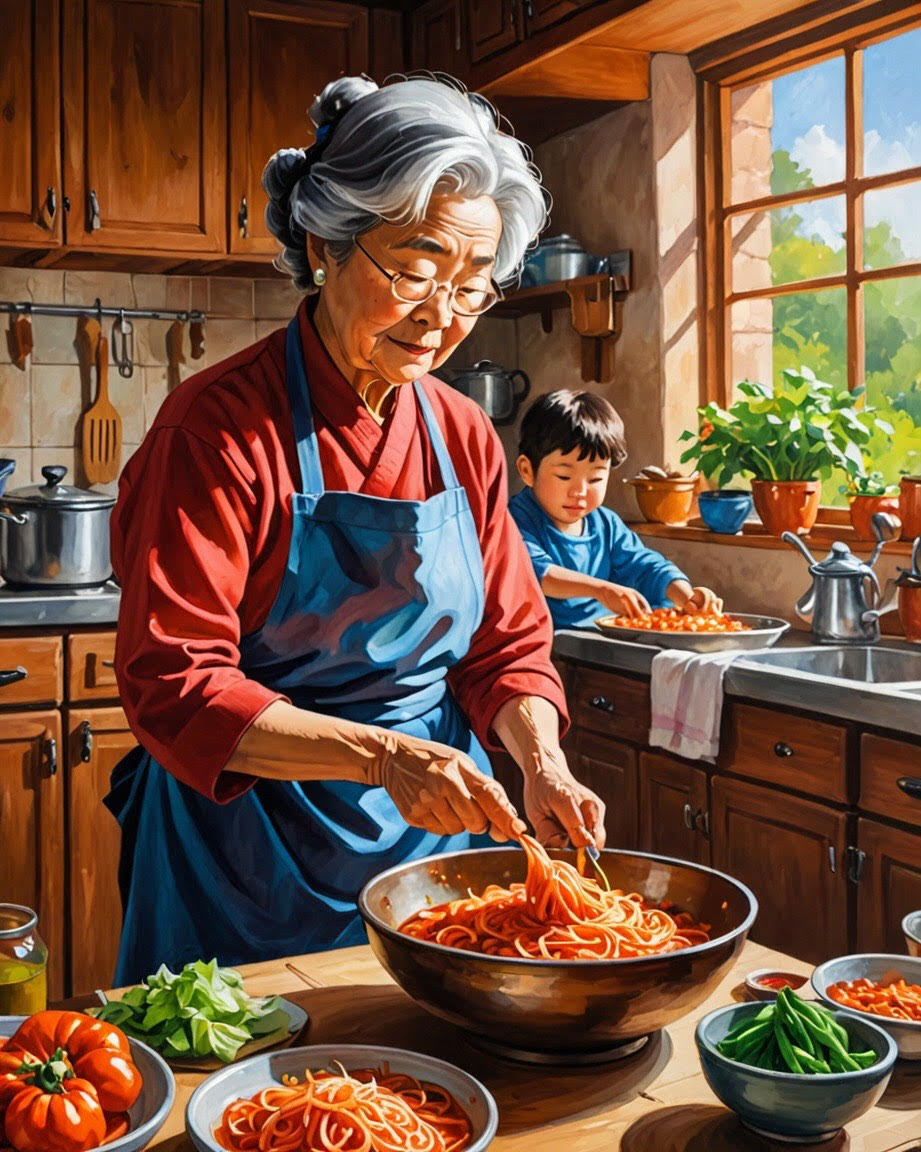
Long, long ago, in the misty hills of the Korean Peninsula, there was a village where life was peaceful for all.
In this village lived a halmoni (grandmother) named Jang. People would gather at her house to listen to folk stories, learn about herbal medicines, and most of all, to enjoy her most treasured creation—kimchi.
The kimchi had a magical way of warming souls. Its spicy, tangy flavor attracted everyone.
During those times, there were no supermarkets or even refrigerators. Winters were so harsh that they covered the ground and rivers in ice. The villagers often faced challenges preserving their food, so many of them dried fish and salted meats.
Halmoni Jang had a special recipe passed down from her ancestors. Every autumn, she would gather fresh cabbage, radishes, garlic, ginger, red pepper flakes, and salt. She’d invite the entire village to help prepare it.
Everyone would come together, mixing the ingredients by hand. Once finished, they packed the mixture tightly into large earthen jars known as onggi. These jars were buried deep underground to slowly ferment through the winter.
One day, a curious child asked her, “Halmoni, what is this food we are making?” Halmoni Jang smiled and replied, “This is kimchi. The earth will help it grow strong, and it will keep our hearts warm on the coldest days.”
As time passed, kimchi became a tradition in Korean homes, and today, it is known and loved around the world. Every family makes their own version and passes it down through generations.
Kimchi is not just food—it’s a symbol of working together, respecting nature, and honoring the past.
It has remained through wars and modern changes. Today, kimchi stands as a proud symbol of Korean identity. No Korean meal is complete without it. In every home, on every table, you’ll find kimchi—reminding people of their roots, traditions, ancestors, and families.
 The Korea Times Xpress