
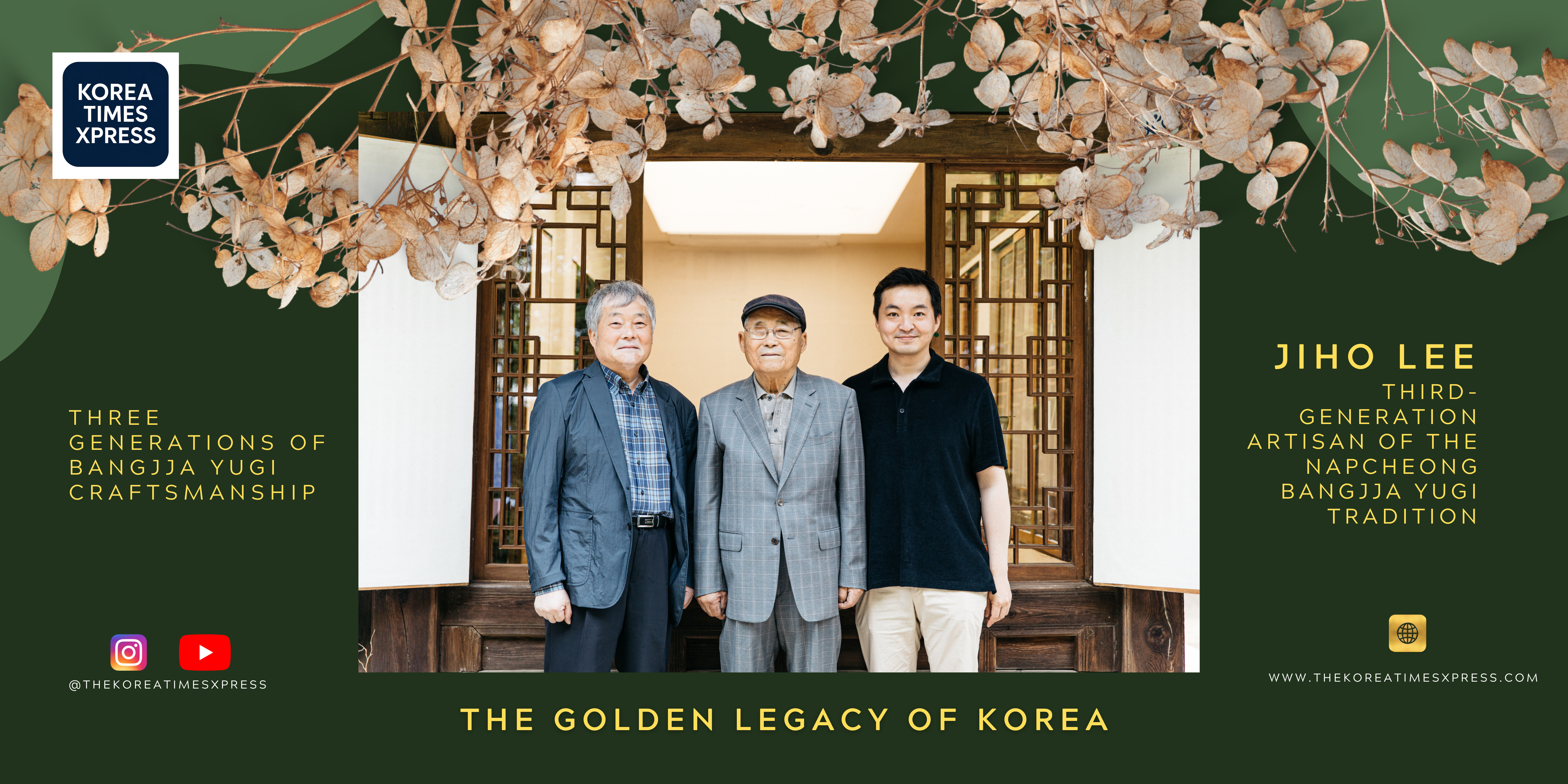
Bangjja Yugi is more than traditional Korean tableware. Forged through fire, heat and repeated hammering, it represents a distinctive tradition of Korean metal craftsmanship shaped by patience, precision and generations of knowledge.
Raised around the workshop of his grandfather, Master Lee Bong-ju, Honorary Holder, and father, Master Lee Hyung-geun, Holder, he grew up witnessing the demanding physical work and dedication behind the craft.
Today, he carries that family legacy forward while exploring how Bangjja Yugi can remain relevant in contemporary life. From the meaning of handcrafted imperfection to the role of traditional craft in the global interest in Korean culture, his story offers an intimate perspective on preserving heritage while allowing it to evolve.
You are the third generation of your family’s BangjjaYugi tradition. What inspired you to continue this legacy?
Because my grandfather (Master Lee Bong-ju, Honorary Holder) and father (Master Lee Hyung-geun, Holder) silently protected Korea’s traditional Bangjja Yugi technique through a barren environment and countless hardships, I am able tocontinue this precious lineage today. Making brassware is incredibly physically demanding work, yet every time they worked, they were always overflowing with passion and genuinely looked happy. Even as a child, the thought naturally came to me: “If a job you dedicate your entire life to can bring that much happiness, I want to walk that path too.” Their joyful presence, blooming even amidst the grueling labor, was the single greatest catalyst that led me to choose the path of an artisan.

What is your earliest memory of watching your grandfather and father work with Yugi?
In my childhood memories, the workshop was always a dark place filled with coarse, rugged sounds. Because it was so dangerous, I couldn’t enter often, but the sensory memories of that place remain vivid to this day. The heated metal glowing red through the darkness, the deafening mechanical roars, and the thunderous hammering still echo clearly. Amidst all that noise, my grandfather and father buried their gaze solely on their fingertips. Seeing their towering silhouettes—drenched in sweat before the blazing sparks, silently swinging their hammers—remains deeply engraved in my mind as my very first memory of the artisan spirit.

What makes Bangjja Yugi uniquely Korean, in your view?
South Korea is currently the only country in the world that utilizes this copper and tin alloy technique to produce and pass down a diverse range of products, spanning from everyday tableware to various household goods. In other countries, the use of this metal is mostly confined to musical instruments like cymbals or gongs. Free of toxicity, inherently self-sterilizing, and emanating a deeper, more subtle golden charm the more it is used, Bangjja Yugi is the most uniquely Korean cultural heritage—an condensation of our ancestors’ wisdom and peerless technical mastery.

How has working with metal shaped your understanding of patience and craftsmanship?
When metal is heated in the furnace, it will inevitably shatter or melt away if you become impatient or driven by greed. Watching a raw block of metal transform into a refined vessel through tens of thousands of honest hammer strikes made me realize with my entire being that craftsmanship goes beyond mere technical skill; it is a profound process of patience that requires mastering one’s own inner self.

How do you balance preserving tradition with creating contemporary designs?
The precise 78:22 golden ratio of copper and tin, along with the traditional Bangjja method of heating and hand-hammering the metal to increase its density, is an uncompromisable essence and a realm that must be strictly preserved. Conversely, the forms and designs of the objectsmust continuously evolve to naturally harmonize with modern living environments and contemporary lifestyles. Recently, even when making a small spoon or a single plate, I design the shape and functionality for modern sensibilities while strictly adhering to the 100% traditional Bangjjamanufacturing method to maintain that perfect balance.

You place great importance on everyday usability. Why is this important for traditional craft today?
I believe that a tradition locked away in a museum, never actually used in daily life, loses its vital life force. It is crucial to guide the public to become familiar with Bangjja Yugi, starting with products they can easily encounter and use in their everyday routines. Just as our ancestors crafted not only tableware but also an entire spectrum of household goods from brassware, traditional craft can truly breathe as a modern lifestyle—rather than remaining a relic of the past—onlywhen its everyday usability is firmly established.

Your work embraces natural variations created through hammering. What does imperfection mean to you?
Dishes perfectly stamped out by machines in a factory look neat and flawless, yet they carry a certain cold, sterile feeling. On the other hand, the subtle contours and hammer marks naturally left on the surface of Bangjja Yugi serve as a one-of-a-kind decoration, proving the time, rhythm, and devotion the artisan poured into creating that specific vessel. To me, this ‘imperfection’ is not a defect; rather, it signifies the ‘most perfect beauty,’ imbued with the human touch and a warm, analog vitality. For practical and hygienic reasons, we refine the inner surfaces where lips touch or food is placed to a smooth finish, while deliberately preserving the beautiful hammer traces on the exterior to maximize the rich texture of handcraftsmanship.
Do you see Bangjja Yugi as a form of cultural storytelling? What does it tell the world about Korea?
Bangjja Yugi is, in itself, a magnificent medium for cultural storytelling. The deep, subtle golden hue of the tableware represents Korea’s long history, noble manners, and the profound sincerity with which we treat food. Furthermore, the arduous process of hammering a glowing red block of metal thousands of times to forge the strongest yet most refined vessel mirrors the resilient spirit of the Korean people. It shows the world our robust nationhood and enduring vitality—how we have silently protected our culture and grown stronger through countless hardships and trials.
How can traditional Korean crafts connect with younger generations?
We must lower the ‘barrier to entry’ so that the younger generation does not perceive traditional craft as something difficult or outdated. We need to introduce lifestyle objects with sophisticated designs that feel entirely organic, not just on a modern dining table, but in any contemporary living space. When younger generations can directly touch and experience the charm of Yugi in their daily lives, tradition will naturally be consumed and passed down to the next generation, instead of remaining stagnant in the past.

Your work has reached audiences beyond Korea. What reactions from international audiences have stayed with you?
Driven by the global wave of K-Culture, international interest in Korean heritage has risen, leading to a significant increase in inquiries from overseas customers and collaborations with global corporations. In particular, the moments when international fine-dining chefs and art collectors encountered Bangjja Yugi and praised it as “a piece of art that endures through time” rather than just a mere bowl, remain deeply etched in my memory. I feel an immense sense of fulfillment as an artisan when the world recognizes the value and the irreplaceable human touch that machines can never replicate.
What can traditional craftsmanship contribute to the global wave of interest in Korean culture?
While the world’s current attention is predominantly focused on pop culture, traditional craftsmanship can serve as a vital anchor that showcases the true ‘depth and roots’ of Korean culture. By revealing the technical heritage that a single family has protected as dearly as life itself for hundreds of years, we can imprint upon the global stage that Korean culture is not merely a passing, temporary trend, but is built upon incredibly solid historical and artistic foundations.
What new forms or possibilities would you like to explore through Bangjja Yugi?
Just as our ancestors crafted almost all everyday lifestyle objects from brassware, I hope to one day expand far beyond the boundaries of simple tableware or kitchen utensils. I want to break through the conventional limitations of Bangjja Yugi techniques and introduce the public to a broader, grander spectrum of artistic forms—such as lifestyle objects, interior accessories, lighting, or even avant-garde collaborations with contemporary fine art.

What do you hope future generations will inherit from your family’s craft—and from your own work?
Even in an environment where we could never realistically compete with mass-produced factory goods, what our family steadfastly protected was not a lower price, but ‘handcrafted value.’ I hope that future generations inherit through our workshop not just simple manufacturing techniques, but the ‘steadfast attitude and pride’ of an artisan—someone who keeps their peace of mind and composure to silently protect true value, no matter how grueling or harsh the circumstances. Furthermore, through my own work, I hope they inherit the ‘boundless possibility’ that tradition can still be beautifully used and lived in today.
Bangjja Yugi is ultimately a story of hands, fire, patience and inheritance.
Across three generations, this family tradition demonstrates that preserving cultural heritage does not necessarily mean keeping it frozen in the past. Its techniques can remain firmly rooted in tradition while its forms, applications and possibilities continue to evolve with contemporary life.
From the glow of molten metal in a childhood workshop to the vision of Bangjja Yugi appearing in modern interiors, lighting, lifestyle objects and contemporary art, the craft continues to tell a story about Korea—one shaped not only by history, but by the people who continue to make it.
And perhaps that is the enduring strength of living heritage: it survives not simply because it is remembered, but because someone chooses to keep making it.