
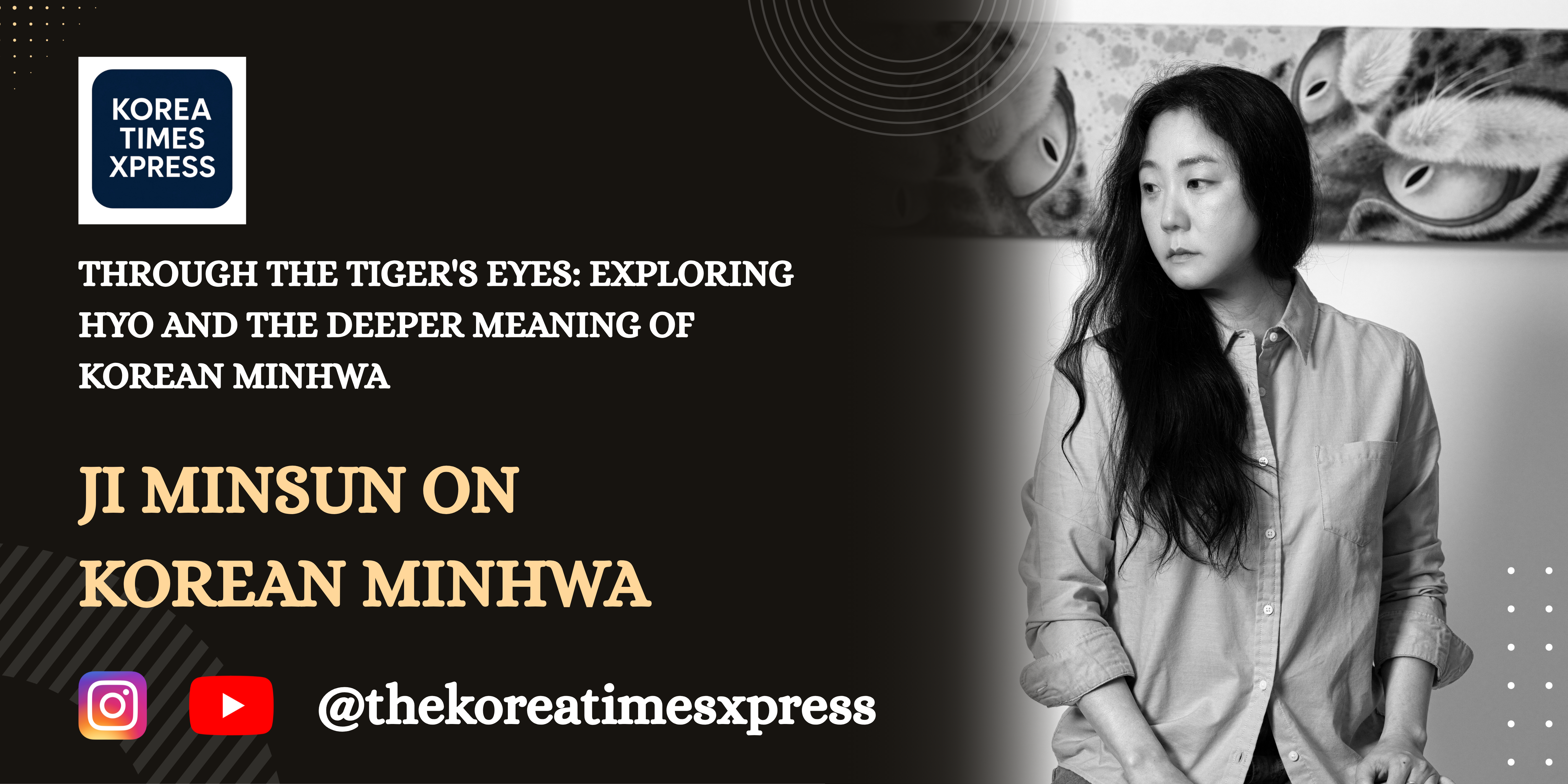
Korean Minhwa, traditionally known as Korean folk painting, is more than an expression of vibrant colours and symbolic imagery. It reflects the hopes, beliefs, values and everyday lives of the people who created it. In this interview, we explore how a contemporary Minhwa artist Ji Minsun reinterprets this traditional art form through personal expression and timeless Korean values. From the symbolism of the tiger to the philosophy of Hyo (孝), the artist shares how ancient stories and cultural traditions can find new meaning in the modern world.
What first drew you to Korean Minhwa, and how has it shaped your artistic journey?
I came to Minhwa after studying visual design. At first, I was drawn to its vivid colors and its simple, free way of expression. While I was learning by copying old paintings, I focused on technique. Over time, I came to see that Minhwa holds people’s lives and wishes. So I do not think of Minhwa only as a painting tradition of the past. The hopes people once put into these pictures still mean something to us today.
Your work reinterprets traditional Minhwa symbols in contemporary ways. What inspires you to transform these traditional visual languages?
When Minhwa was first made, it carried the lives and wishes of the people of that time. So to paint Minhwa today, I believe, is to carry the stories of the people living now. That is why I respect the traditional symbols but do not simply repeat them. I try to read them again with today’s feelings and today’s eyes. I often find my motifs in old folktales. Folktales hold lessons that touch the heart, and I look for my own reading of them and find new meaning in them.


What does Hyo (孝) mean to you personally, and what led you to explore it through your art?
To me, Hyo is less an old virtue than the basic attitude of the heart that a person should have. When I painted my Hyoje Munjado series in 2018, I did not follow the traditional imagery as it was. I drew one stroke of each character as a heart, because I wanted the meaning of the characters to be kept in the heart, not only in the head. These days I often see news of child abuse. Each time, I wish we could see who is carrying a beast in their heart. At the same time, it reminds me how precious it is to grow up deeply loved by one’s parents, and to return that love with gratitude and care. To live that way is itself a blessed life, and that is the heart I wanted to paint as Hyo.
In your Munja-do: Hyo, the tiger and the character 孝 carry important symbolism. Could you explain the story and meaning behind this work?
This work began with an old Korean story about the tiger’s eyebrow. According to the tale, looking through a tiger’s eyebrow lets you see the true nature of others. I wanted to borrow the tiger’s insight and ask one question: is there Hyo in our hearts? The tiger is frightening, but it is also the one who protects us. In this painting, the tiger is the eye that looks into the human heart, and the character 孝 is the heart that eye is searching for. In my Hyoje Munjado series, I placed the tiger as the earth and the dragon as the sky, and in eight characters I painted the attitude a person living between them should keep. Munja-do: Hyo reads the very first of those, Hyo, once more through the tiger’s eyes.
How do you balance preserving traditional Korean symbolism with experimentation and your own artistic expression?
I do not see tradition and the contemporary as separate things. The past and the present connect to make the future, and I believe today’s Minhwa will become tradition in the future. What matters is not the form but the universal meaning Minhwa carries. Even as the form becomes new, I hope the heart inside it stays the same.
How do you think the meaning of Hyo can be understood by younger generations in contemporary Korea?
Hyo may look like an old value, but I believe the heart that cares for and feels grateful to family has not changed. The way we show it changes with the times, but the heart is the same. I hope my paintings can be a moment to remember that heart.


What do you hope international audiences discover about Korean culture through your work?
Even without knowing the symbols, international audiences often respond first to the feeling a painting gives. At my exhibition in Saint Petersburg, one visitor told me that although these were Korean paintings, they did not feel unfamiliar. Those words still stay with me. I believe we can share feelings through painting across language and culture. I hope my work brings them warmth and comfort.
Are there other Korean cultural values, stories or traditions you hope to explore in your future work?
I always work with the tiger as my theme, and I will continue to. But the stories I want to tell through the tiger are growing. In my Beom-Gimyeongdo series, where the tiger holds a vessel of good fortune, I spoke about in (因) and yeon (緣), the cause and the connection that bring people together. A good cause matters, but so does a good connection. And I covered the solitary tiger with lichen, a living symbol of coexistence, to speak about living together and helping one another. If Hyo is the heart between parents and children, I would like to paint how that heart reaches out to neighbors and to the world, and to explore more deeply the value of living together, leaning on one another.
Through the language of Minhwa, the artist reminds us that tradition is not something confined to the past; it is something that continues to evolve with each generation. Whether expressed through the watchful eyes of a tiger, the meaning of Hyo, or the symbolism of living together in harmony, these paintings carry messages that transcend cultural and linguistic boundaries.
Ultimately, the heart of Minhwa lies not only in the symbols it preserves but also in the human emotions and universal values it continues to communicate. Through contemporary interpretations of Korean folk art, the artist keeps these stories alive, allowing their warmth, wisdom and meaning to reach audiences across the world.