
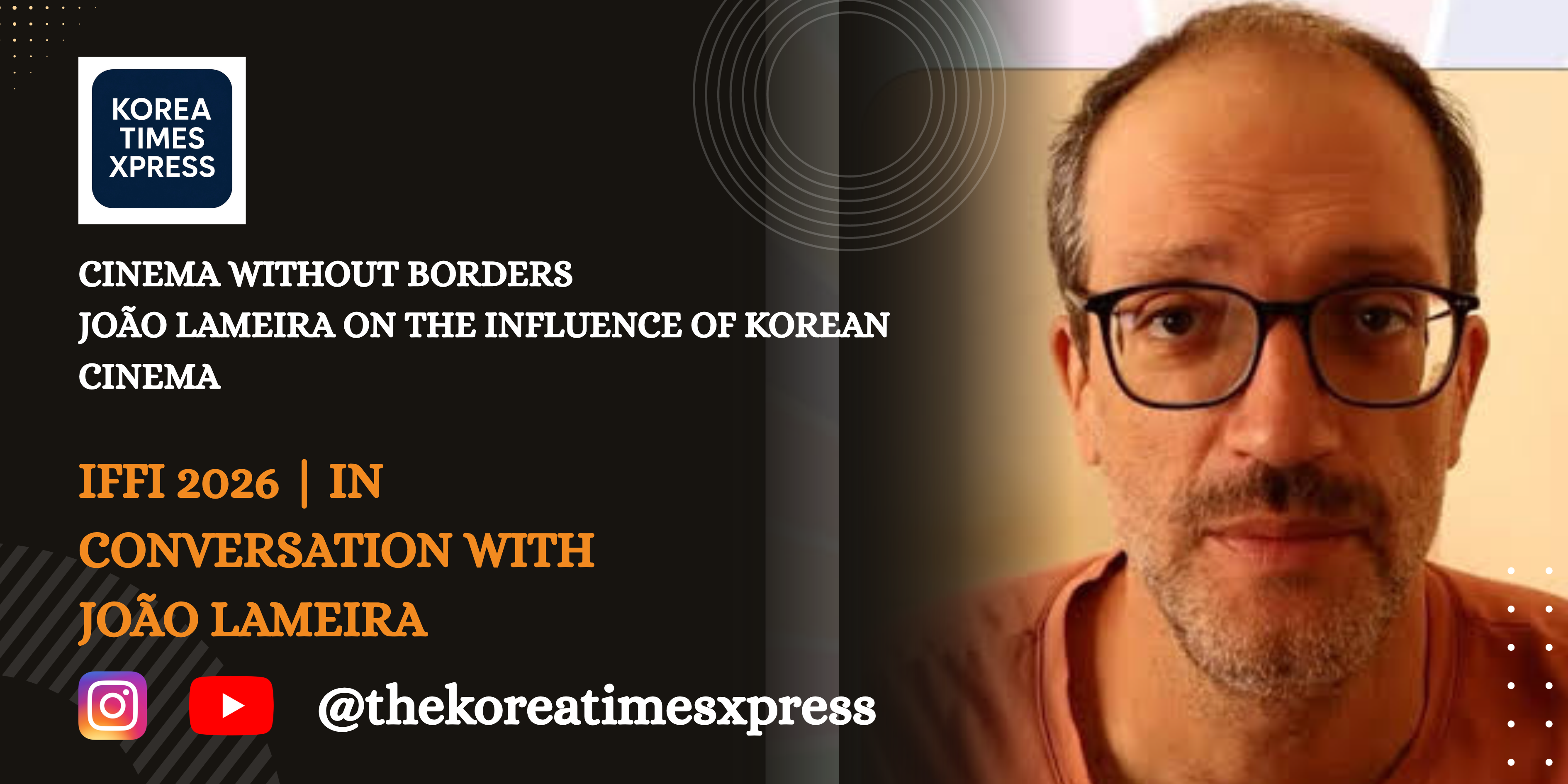
At the 57th International Film Festival of India (IFFI) 2026, cinema becomes a meeting point for stories, influences and cultures that transcend borders. Portuguese filmmaker João Lameira, whose debut feature Anda daí (Come with Me) received its world premiere at the festival, speaks about his admiration for South Korean cinema, the influence of Hong Sang-soo on his own filmmaking, and the possibilities of connecting Portuguese independent cinema with Korean audiences.
From the quiet absurdity of everyday life to the universality of deeply personal stories, Lameira reflects on how cinema travels across cultures—and why distinctive voices can resonate far beyond their own borders.
Have you watched any Korean films or been influenced by Korean filmmakers?
I’ve watched many South Korean films, by Park Chan-wook, Bong Joon-ho, Kim Ki-duk and others. But I’m especially influenced by Hong Sang-soo: his small narratives, recurring characters and light, absurdist comedy. In my first feature, Anda daí (Come with Me), I even “stole” a moment from one of his best films, Right Now, Wrong Then.


What do you admire about the global success of Korean cinema?
After Hollywood and Bollywood, South Korea is probably one of the world’s leading film producers, in terms of quantity, quality and international reach.
Do you see similarities between Portuguese and Korean storytelling traditions?
It depends. As I’ve said, Hong Sang-soo is, in a way, a very “European” director. But other well-known Korean directors tend to work more in genre cinema, which has often been overlooked in Portugal.
How can independent Portuguese films connect with Korean audiences?
In the same way that films by Hong Sang-soo can reach Portuguese audiences — and they do — I don’t see why Portuguese films couldn’t connect with South Korean audiences. I’d even say that the more distinctive and idiosyncratic a film is, the better: there’s a universality that stands out when stories become more personal.
Would you be interested in exploring a future film project or collaboration involving Korean artists or filmmakers?
I think I’ve already answered this in my previous response. I’d definitely be interested in exploring a collaboration involving Korean filmmakers, especially Hong Sang-soo.
Are there any Korean directors or films you would love to collaborate with or learn from?
I think I’ve already answered this, but definitely Hong Sang-soo, who is one of my favourite directors overall.
Do you think international film festivals like IFFI can create stronger cinematic connections between Portugal and South Korea?
Yes. Any international film festival can create stronger ties between filmmakers from different parts of the world. That’s one of their strong points.
For Lameira, cinema’s strongest connections often emerge from the most personal stories. His admiration for Hong Sang-soo reflects an openness to filmmaking that is intimate, unconventional and quietly universal—qualities he believes can help Portuguese films find audiences in South Korea, just as Korean cinema has found admirers in Portugal.
As IFFI brings filmmakers and audiences together from across the world, his reflections leave open the possibility of future creative exchanges between Portugal and South Korea, perhaps even collaborations inspired by the director he admires most. In the end, cinema’s ability to cross borders may begin with something simple: a story that feels deeply personal to one filmmaker, yet familiar to someone on the other side of the world.