
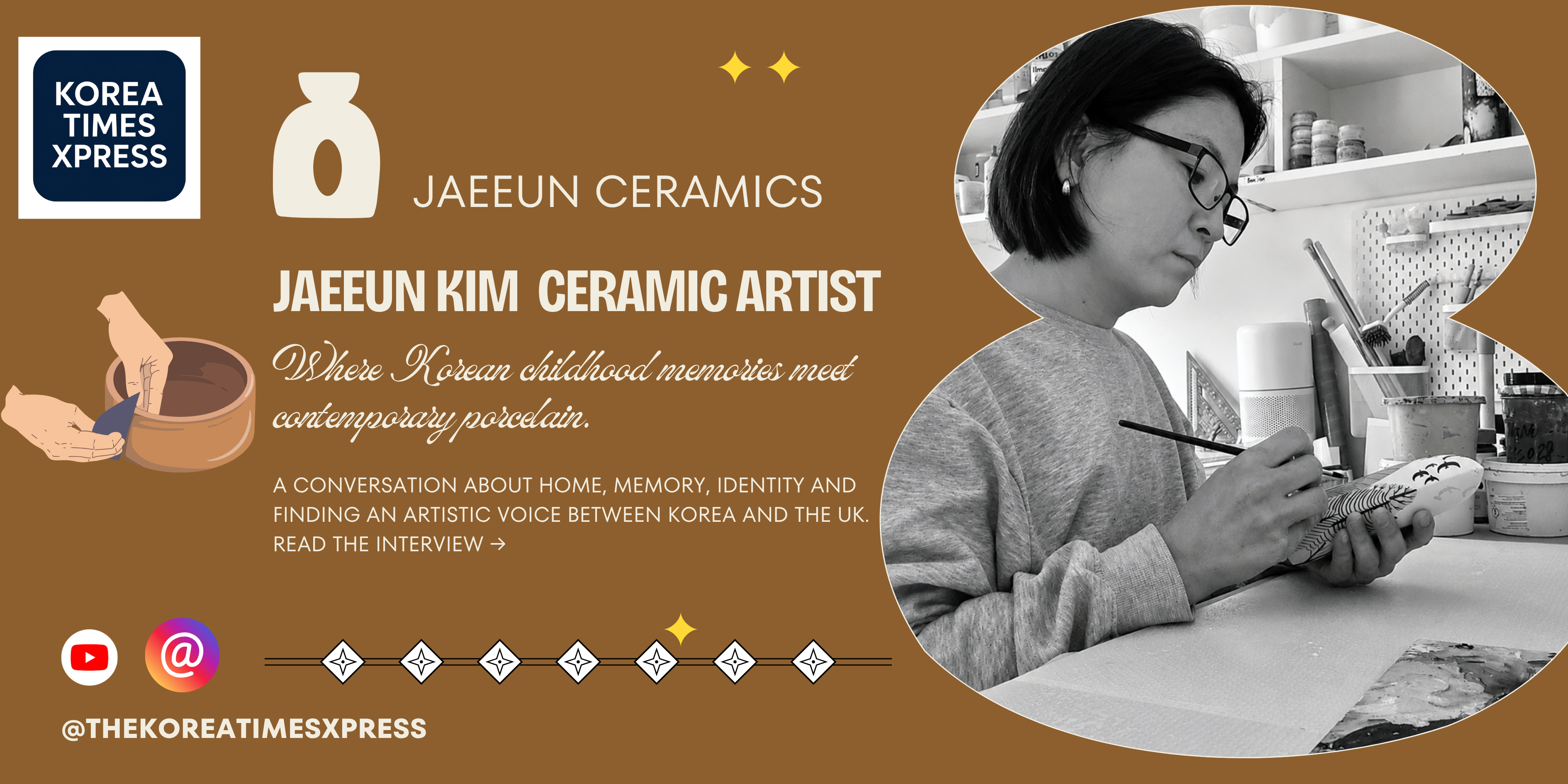
For ceramic artist Jaeeun Kim, home is not simply a place it is a journey through memory, emotion and the experiences that stay with us long after we have left a familiar place.
Born and raised in Korea and now living and working in the UK, Kim’s contemporary porcelain practice explores childhood memories, landscapes, paths and the emotional meaning of returning home. Her series The Way Home emerged gradually through a process of self-discovery, drawing inspiration from memories of walking home from school and the quiet moments spent observing familiar streets and changing seasons.
In this conversation with The Korea Times Xpress, Jaeeun Kim reflects on childhood, art therapy, porcelain, Korean aesthetics, cultural identity and the experience of building an artistic career internationally. She also shares why she hopes her ceramics do not simply tell her story, but give viewers the space to discover their own.
Your work often speaks about “home. ” Has your understanding of home changed over the years as you’ve lived between Korea and the UK?
Home has always been an important idea in my work, even before I moved to the UK. Looking back, I realise that my interest in home began with the way I understood it as a child. Just as the meaning of home is different for everyone, I think my own understanding of it was shaped by my personal experiences from an early age.
When I began thinking about the idea of home, I wasn’t trying to define what it meant. Instead, I found myself reflecting on why it had always held such significance for me. Living in the UK encouraged me to think about those questions more deeply. Being physically distant from the place where I grew up gave me the opportunity to look back at my memories from a different perspective.
Over time, I realised that my work wasn’t really about a house or even a particular place. It was about the journey back to the memories and emotions that shape our idea of home. Perhaps that’s why the series is called The Way Home. Today, I don’t think of home simply as a physical place. It’s something built through our memories, relationships and experiences. Rather than defining what home means, I hope my work offers a quiet space for people to reflect on what home means to them.
Looking back, what lessons from your childhood in Korea continue to influence your work today?
Looking back, I don’t think the most important lesson from my childhood was about home itself. It was about the journey. One of my strongest memories is walking home from school. It wasn’t always a journey I looked forward to. There were times when I deliberately took a longer route, simply to spend more time on my own before arriving home. Those walks became a quiet space where I could observe the changing seasons, familiar streets, and the small details around me, while also sitting with my own thoughts and emotions.
Only later did I realise how much those moments had shaped me. They taught me that the time between one place and another can be just as meaningful as the destination itself. I think that’s where my work really began, not in the idea of a house, but in the experience of the journey.
That understanding continues to influence my practice today. The Way Home isn’t about arriving home; it’s about the memories, emotions and quiet moments we encounter along the way. I hope my work offers a space where people can pause, reflect, and perhaps reconnect with their own journeys.
Was there a particular piece that made you feel you had truly found your artistic voice?
While studying art therapy, I was introduced to the House-Tree-Person (HTP) method. Rather than analysing the drawings, I became interested in using its spontaneous approach as a way of expressing my own experiences through ceramics.
I began making work based on several personal themes, without trying to tell one particular story. Looking back, I realised I kept returning to images of houses, paths and landscapes from my childhood. That’s when I understood that I had been telling the story of my journey home all along.
Finding my artistic voice wasn’t about inventing a new idea. It was about recognising the story that had already been emerging through my work.


Although your work is contemporary, do you feel Korean aesthetics naturally appear in your ceramics?
Yes, I think they do, although not consciously. I don’t set out to make work that looks traditionally Korean, but I believe my cultural background naturally influences the way I think about form and space. Growing up in Korea gave me an appreciation for simplicity, balance and quietness, and those qualities continue to shape my work.
At the same time, living in the UK has had a strong influence on my use of colour. I often say that Korea taught me about form, while the UK taught me about colour. Bringing those two experiences together has become an important part of my practice.
Rather than trying to represent one culture or the other, I see my work as a conversation between both. My Korean background gives my work its foundation, while my life in the UK continues to expand the way I express it.
Are there traditional Korean ceramic techniques or philosophies that continue to inspire you?
To be honest, when I was studying ceramics, I wasn’t particularly interested in traditional Korean ceramics. I was more drawn to contemporary practice.
It was only after moving to the UK that I began to appreciate Korean ceramics from a different perspective. Looking at moon jars and white porcelain with some distance, I came to understand why they have been admired for so long. I now have great respect for their quiet beauty and craftsmanship.That said, my own work isn’t based on traditional Korean ceramics. Rather than following traditional forms, I try to express my own experiences in a contemporary way.
How important is it for you to preserve elements of Korean identity while creating for an international audience?
I don’t consciously try to preserve or emphasise Korean identity in my work. Of course, growing up in Korea has shaped the way I see the world, so that naturally becomes part of what I make. But I don’t begin a piece thinking about how to make it feel Korean.
What matters most to me is being honest about my own experiences. If something of Korea is reflected in my work, I think it comes naturally through my memories and perspective, rather than through deliberate references to tradition.
Your pieces feel deeply emotional. How do you know when a vase has fully expressed the story you wanted to tell?
I don’t usually begin with detailed sketches. While studying art therapy, I was introduced to the House-Tree-Person (HTP) method, where people are encouraged to draw the first house, tree and person that come to mind. I was inspired by that spontaneity, although it isn’t possible to work in exactly the same way with ceramics.
Instead, I try to bring that openness into my practice. Rather than planning every image in advance, I leave room for memories, emotions and unexpected ideas to emerge as I paint.
Sometimes I only understand what a piece is really about when it is nearly finished. I know it is complete when I no longer feel the need to change it. That’s when it feels as though the vase has found its own story.
Does working with porcelain require patience in ways that have also shaped your outlook on life?
Porcelain is a demanding material, so I spend a lot of time testing before I begin making finished pieces. I test colours, slip, glazes and firing conditions because I want to minimise mistakes as much as possible.
Even with careful preparation, porcelain can still surprise you. Things don’t always turn out as I expected, and there are times when I have to start again from the beginning.Over time, I’ve learned not to see that as a failure. Instead of trying to control every outcome, I’ve become more comfortable accepting what happens and beginning again when necessary. I think porcelain has taught me patience, but also the importance of leaving room for uncertainty.
Are there colours, textures, or landscapes from Korea that repeatedly find their way into your work?
I don’t consciously try to include Korean colours, textures or landscapes in my work. The memories I paint all come from my childhood in Korea, so those elements naturally find their way into the work.
Rather than depicting specific places, I’m interested in expressing the feeling of those memories. I think my Korean background is present not because I intentionally include it, but because it is where those memories were formed.
You combine ceramics with insights from art therapy. Have visitors ever shared stories that surprised or deeply moved you after connecting with your work?
People don’t often share deeply personal stories with me, and I completely understand why. Those memories are very private. I don’t usually explain the personal story behind my own work either, because I hope people will find their own stories in it rather than mine.
Sometimes people do tell me that they bought a vase to remember a beloved dog or cat they had lost, and those conversations are always very touching.
One person I remember most, though, never said anything at all. She stood in front of my work for a long time and quietly cried before walking away. We never spoke, so I’ll never know what she was remembering, but that moment has stayed with me. It reminded me that art doesn’t always need words to create a connection.
In today’s fast-paced world, do you believe handmade ceramics can encourage people to slow down and reconnect with themselves?
I hope so, although I don’t think ceramics have that effect on everyone. Making ceramics certainly encourages me to slow down. The process is time-consuming, and porcelain doesn’t allow you to rush. It requires patience and attention, and I think that way of working naturally influences how I see the world.
If someone spends a little longer looking at my work, or if it gives them a quiet moment to reflect on their own memories or feelings, then I’m very happy. I don’t expect my work to change people, but I do hope it can create a small pause in a busy day.


Having exhibited across the UK, how have international audiences responded to Korean ceramic artistry?
From my experience, traditional Korean ceramics are very well received internationally. I have many friends whose work is rooted in traditional techniques, and I’ve seen their work earn a great deal of respect from audiences, collectors and museums. The craftsmanship and artistic quality are highly valued.
My own work is different. People usually respond to it through the stories and emotions they find in it before they think about where I’m from. If they later discover that I’m Korean, they’re often interested in how my background has shaped my practice.
I think both approaches show different aspects of Korean ceramics. Traditional ceramics introduce Korea’s rich ceramic heritage, while contemporary artists bring their own personal experiences and perspectives. Both contribute to how Korean ceramics are understood internationally.
Have you noticed differences in how Korean and overseas audiences interpret your work?
I haven’t had the opportunity to exhibit in Korea yet, so it’s difficult for me to compare. Most of my experience has been with international audiences. It would be interesting to see whether Korean audiences respond differently in the future.
What advice would you give young artists who want to build an international career while staying connected to their cultural roots?
I don’t think you need to consciously try to make your work look culturally distinctive. If your work is honest and comes from your own experiences, your cultural background will naturally be part of it.At the same time, don’t be afraid to learn from different places and different cultures. Living in the UK has changed the way I think about colour and my practice, but it hasn’t changed where my memories come from.
For me, building an international career isn’t about leaving your roots behind. It’s about allowing your work to grow while staying true to yourself.
What would you like people to remember about Jaeeun Kim and her ceramics many years from now?
I don’t mind whether people remember my name. I would be happy if they remembered how my work made them feel If one of my pieces reminds someone of home, brings back a forgotten memory, or simply gives them a quiet moment in their day, then I feel it has done its job.
I hope my ceramics continue to encourage people to pause, reflect, and discover their own stories, even many years from now.
Jaeeun Kim’s work ultimately asks us to slow down. Her ceramics are not intended to provide a single interpretation of home, memory or identity. Instead, they create a quiet space in which viewers can bring their own experiences.