
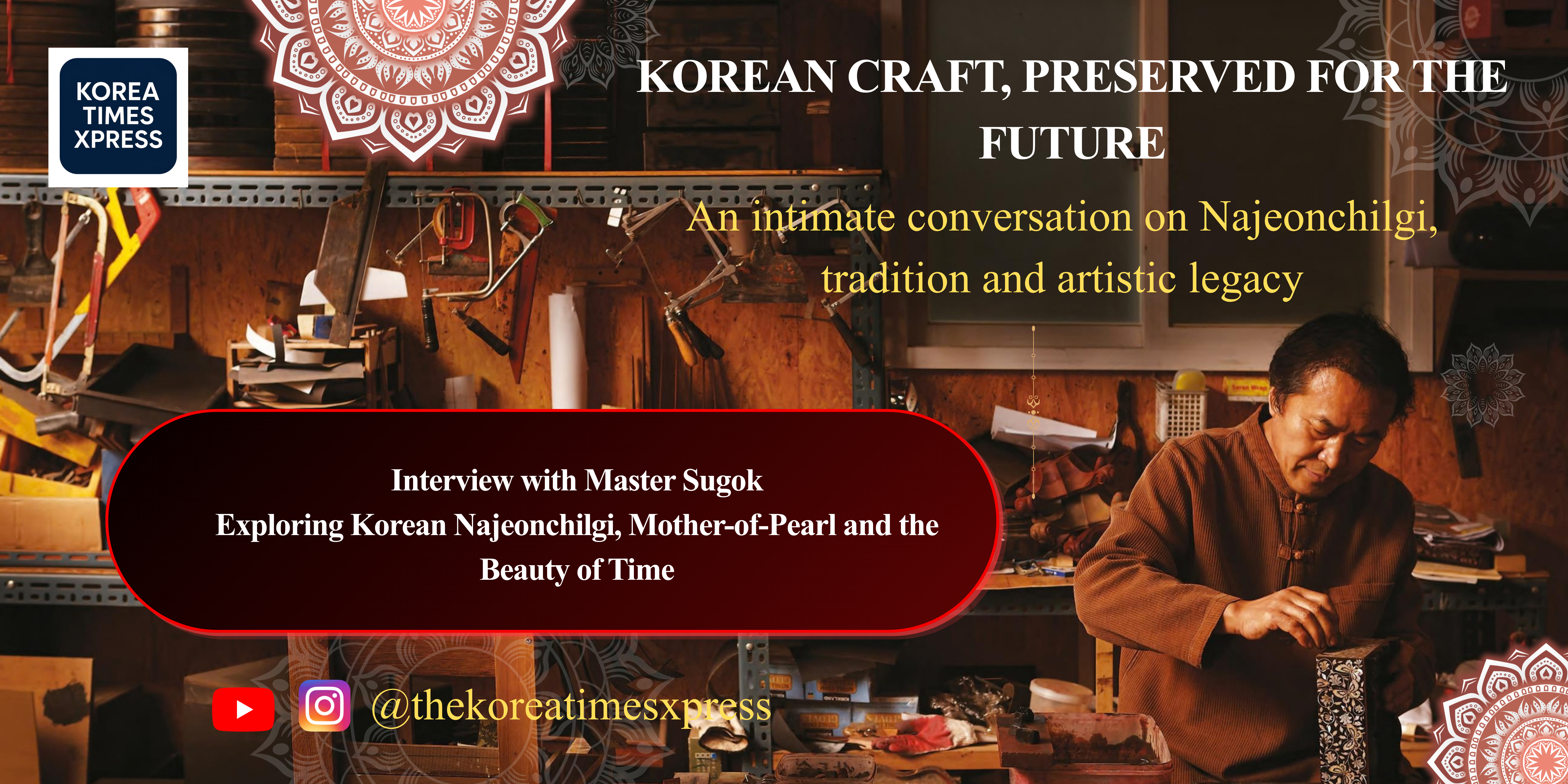
From the shimmering surface of mother-of-pearl to the patient layering of natural lacquer, Korean najeonchilgi carries a remarkable story of time, craftsmanship, and cultural memory. For master artisan Sugok, a childhood encounter with the luminous beauty of mother-of-pearl became the beginning of a lifelong journey dedicated to preserving and evolving Korean lacquer art.
In this conversation, he reflects on his apprenticeship, the responsibility of carrying the Sugok artistic lineage, his reinterpretation of the traditional moon jar, collaborations with global luxury brands, and his hopes for the future of Korean traditional craft. At the heart of his philosophy is a simple belief: true craftsmanship is found not only in what the eye can see, but also in the countless invisible hours behind it.
What first inspired you to pursue Korean lacquer and mother-of-pearl craft?
What first inspired me was the luminous beauty of mother-of-pearl. Around 1964, when I was fifteen, I worked at a small trading company near Seoul Station. There was a lacquerware workshop in the same building, and I often stopped by to watch the artisans at work. One day, I saw them packing finished jewelry boxes and trays. As the mother-of-pearl caught the light, it shimmered in many different colors. I was completely captivated and immediately thought, “This is what I want to learn.”
I began by learning cashew lacquer, which was widely used at the time. However, the more I learned, the more strongly I wanted to master traditional Korean ottchil, or natural lacquer. After repeatedly visiting Master Min Jong-tae, I was finally accepted as his apprentice in 1968. Looking back, that first encounter with the light of mother-of-pearl determined the path of my entire life.
What does carrying the “Sugok” artistic lineage mean to you?
Carrying the Sugok artistic lineage means preserving not only the techniques of previous masters, but also their values and attitude toward craftsmanship. The name Sugok (守谷) was passed down from the first-generation master, Jeon Seong-gyu, to my teacher, Min Jong-tae, and then to me. My teacher entrusted the name to me shortly before he passed away, so I have always regarded it as a responsibility rather than an honor.
My teacher taught me to remain faithful to what cannot be seen. In a finished work of najeonchilgi, or mother-of-pearl lacquerware, people cannot see how many times the surface has been lacquered, dried, polished, and lacquered again. That is why an artisan must be especially honest and meticulous during the invisible stages. I now try to pass this principle on to my son and my students, together with the techniques themselves. To me, carrying the Sugok lineage means protecting what I inherited while ensuring that it continues into the next generation.


How do you balance Korean tradition with contemporary creativity?
I do not see tradition and contemporary creativity as opposites. Tradition provides the foundation, and creativity allows it to remain alive. I believe the essential techniques and processes of Korean lacquerwork must be preserved faithfully. If important stages are omitted or natural lacquer is replaced with a convenient chemical coating, the surface may look similar, but the work loses its depth, durability, and vitality.
At the same time, preserving tradition does not mean merely repeating old forms and patterns. I reinterpret traditional arabesque and dancheong-inspired patterns, sometimes adding butterflies or developing new designs from natural forms such as cracks in ice. I have also applied lacquer and mother-of-pearl to metal, aluminum, automotive interiors, and contemporary art objects. My approach is to keep the roots of tradition firmly in place while allowing its form, function, and artistic expression to evolve with the times.
Your moon jars take months or years to create. What does this process mean to you?
To me, this long process represents patience, honesty, and respect for the natural rhythm of lacquer. A geonchil, or dry-lacquer, moon jar is made by building up multiple layers of hemp cloth and natural lacquer. Each layer must be allowed to dry thoroughly before it is carefully polished and coated again. Mother-of-pearl may then be cut and applied piece by piece, followed by further stages of lacquering and polishing. Depending on the size and complexity of the work, the entire process can take many months or even years.
Natural lacquer cannot be rushed. Its drying and color are affected by temperature, humidity, and the changing seasons, so the artisan must work in harmony with nature. I still feel a sense of anticipation each time I examine a surface that I lacquered the previous day. Every layer records a particular moment of time and a particular movement of the hand. In that sense, my moon jars are not simply objects; they are visible forms created from accumulated time, patience, and devotion.


What inspires you to reinterpret the traditional Korean moon jar?
I was inspired by both the enduring strength of ancient Korean lacquerware and the comforting form of the traditional moon jar. When I saw ancient lacquer fragments that had survived for centuries, I began to think more deeply about the durability and creative possibilities of the dry-lacquer technique. I wanted to bring this historical method into the present through a form that contemporary audiences could understand and feel connected to.
The moon jar’s generous, rounded form reminds me of the warmth and comfort of a mother’s embrace. Rather than simply reproducing the appearance of a ceramic moon jar, I reinterpret it through the layered texture of hemp and lacquer and the shifting light of mother-of-pearl. I hope that when people stand before my moon jars, they can set aside their worries for a moment and experience a sense of peace, warmth, and quiet reflection.
What have collaborations with global brands taught you about Korean craft?
Collaborations with brands such as BMW, Cartier, Gucci, Vacheron Constantin, and Mercedes-Maybach have taught me that Korean craft has the ability to move beyond traditional categories and communicate in a contemporary global context. Lacquer and mother-of-pearl can be applied not only to traditional furniture, but also to automotive interiors, luxury objects, and a wide range of modern materials and designs.
These collaborations have also taught me the importance of maintaining our cultural identity. Collaboration does not mean simply following another party’s ideas. Even when a brand requests something minimal or contemporary, I try to preserve the character of mother-of-pearl and the spirit of Korean decorative traditions. I have learned that when we remain confident in our own techniques and cultural roots, Korean craft can meet global design on equal terms and create something genuinely new. Becoming global does not mean imitating others; it begins with presenting our own tradition with confidence.
How do international audiences respond to your work?
International audiences are usually first attracted by the changing light and color of the mother-of-pearl. Depending on the viewing angle and the quality of light, it can shift between green, blue, pink, and many other colors. People often ask what kind of material could produce such a remarkable effect. When they look more closely and learn about the many layers of lacquer and the countless pieces of shell applied by hand, they become equally interested in the time, discipline, and skill behind the work.
Many international viewers initially associate Asian lacquerware mainly with Japan. When I explain the history and distinctive techniques of Korean najeonchilgi, particularly the extraordinary refinement of Goryeo lacquerware, they are often surprised and deeply impressed. Koreans living abroad sometimes have a more personal response, recalling a mother’s mother-of-pearl cabinet or memories of their childhood home. These reactions have shown me that Korean lacquerware can communicate across languages and cultures while also carrying memories of home.
What do you hope future generations see in your art?
I hope future generations see more than the brilliant surface of the mother-of-pearl. Beneath that light are countless layers of lacquer, repeated polishing, long periods of waiting, moments of failure, and the determination to begin again. I want them to recognize the invisible time, labor, and sincerity contained within each work.
When I first encountered Goryeo mother-of-pearl lacquerware, I felt profound respect for the artisans who had created such extraordinary works nearly a thousand years ago. I hope that one day, someone may look at my work and sense how an artisan of our time tried to preserve and advance this tradition. It is less important that they remember my name than that they recognize the lasting value of Korean lacquerware. I hope gmy art can serve as a bridge connecting the past, the present, and future generations.


How can Korean traditional crafts attract younger generations?
Korean traditional crafts can attract younger generations by becoming something they can experience and relate to directly. Rather than presenting tradition only as something old, difficult, or distant from everyday life, we should give young people opportunities to touch mother-of-pearl, observe how its colors change in the light, and create something with their own hands. The appeal of craft is understood much more clearly through experience than through explanation alone.
Traditional craft must also connect naturally with contemporary life. Lacquer and mother-of-pearl can be introduced through furniture, fashion, everyday objects, automobiles, digital content, and even characters familiar to younger audiences. However, attracting attention should not mean weakening the essential techniques or spirit of the craft. We must preserve its integrity while discovering new forms and uses for the present. When tradition becomes part of contemporary life rather than something seen only in museums, younger generations can discover its value and carry it forward in their own way.
What aspect of Korean craftsmanship would you most like the world to discover?
I would most like the world to discover the profound yet restrained beauty of Korean najeonchilgi. Mother-of-pearl can be brilliant and colorful, but when it is placed against the deep surface of natural lacquer, its radiance becomes quiet, refined, and dignified. I also want people to appreciate how natural materials—lacquer, wood, abalone, and conch shell—are transformed through an artisan’s hands and many years of patient work into objects that can endure for centuries.
Goryeo mother-of-pearl lacquerware had already achieved an extraordinary level of technical and artistic refinement. The surviving works held in museums around the world demonstrate the excellence of that tradition. I want the world to discover that Korean lacquerware is not simply a beautiful heritage from the past, but a living art that can continue to evolve and speak to contemporary audiences. Above all, I hope people will recognize the quiet radiance, technical sophistication, patience, sincerity, and respect for nature embodied in Korean craftsmanship
For Sugok, Korean lacquer is more than a traditional technique—it is a living connection between generations. Every layer of lacquer, every carefully placed piece of mother-of-pearl, and every moment of waiting becomes part of a larger story of patience, sincerity, and respect for nature.
His work reminds us that tradition does not have to remain frozen in the past. It can evolve, enter contemporary spaces, and speak to audiences around the world while remaining rooted in its cultural identity. As new generations encounter Korean lacquer through art, design, fashion, and everyday life, the legacy of najeonchilgi can continue to shine—not only as a heritage of Korea, but as a living art for the future.