
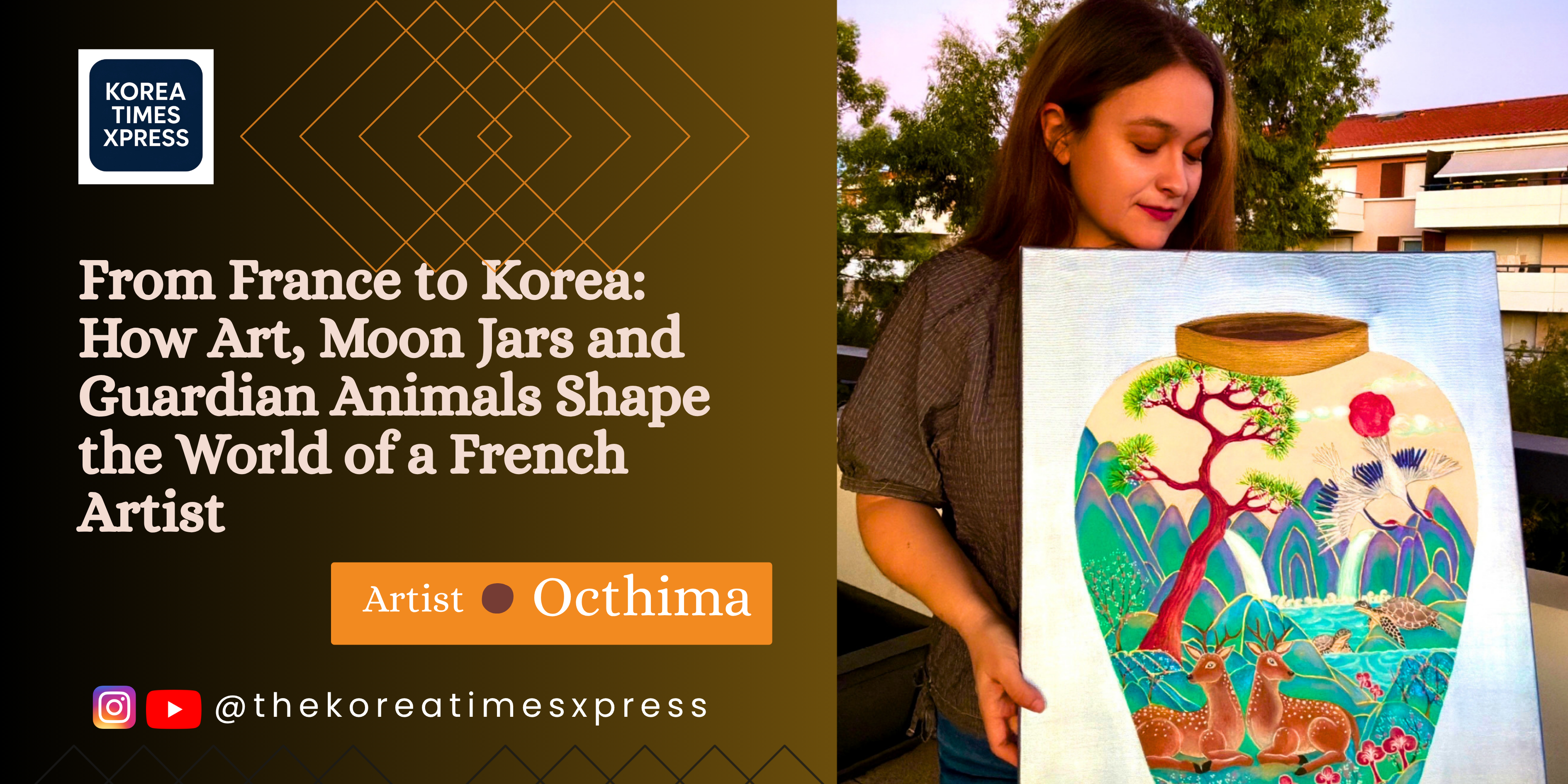
French artist Octhima found a deeper artistic connection with South Korea after her first visit in 2023. Blending French influences with Korean mythology, symbolism and the natural beauty of Jeju Island, she creates expressive Moon Jar-inspired paintings that explore cultural identity, human connection and storytelling. Through her series Women of the World & Their Guardian Animals, Octhima continues to build a distinctive artistic world that bridges cultures.
Your journey began in France, but South Korea became an important part of your artistic identity. What was the moment when you realised Korea was becoming more than simply a source of inspiration?
My first visit to Korea in 2023 was an important turning point. I had been interested in Asian cultures since childhood, but experiencing Korea personally created a much deeper connection. The kindness of the people mattered as much as the places I discovered. Returning to Jeju a few months later strengthened that feeling. I began imagining a life there and taking my artistic dream more seriously. Korea became part of the future I wanted to build, both as an artist and as a mother.
You moved from a career in law and civil service into art. What gave you the courage to make such a significant change, and what has the journey taught you about creativity?
I studied law and spent around seventeen years in the French civil service, but I had been drawing since childhood. During the pandemic, art regained a much larger place in my life, and sharing my work encouraged me to go further. After forty, the thought of never trying began to frighten me more than the uncertainty of change. My late father’s encouragement also stayed with me. This journey has taught me that creativity needs commitment: you have to make room for it, keep working through doubt, and allow yourself to begin again.
Your work brings together French artistic influences and Korean mythology and symbolism. How do these two cultural worlds naturally meet in your paintings?
They meet through storytelling. My French background is part of the way I see and express things, and stories such as La Fontaine’s fables have a place in my artistic world. Korean mythology offers another rich relationship between animals, people and the meaning of life. Painting brings these interests together naturally. Through colour, relief and iridescent details, I give those stories my own visual expression. My Moon Jars are perhaps the clearest example: a recognisably Korean form containing the imagination and emotions of a French artist.
Korean animals such as the tiger, crane, phoenix and dragon carry deep cultural meanings. What first drew you to Korean animal symbolism, and how do you translate those meanings into your own artistic language?
Animals have been part of my imagination and my drawings since childhood. Discovering their place in Korean stories gave me another way to approach a subject I already loved. I was drawn to the possibility that an animal could carry a wish, offer protection or express something difficult to put into words. In my paintings, I develop that emotional presence through its gaze, posture, surroundings and relationship with the other elements. I want the animal to feel like a presence you can connect with, even before you know its story.


Jeju has played an important role in your artistic journey. How has living or working around Jeju influenced the way you see nature, Korean culture and your own art?
Jeju has given my relationship with Korea something very tangible: the sea, volcanic rock, changing light and encounters that become memories. Coming from Marseille, I already have a strong attachment to the sea, so that connection feels personal. In my Jeju Moon Jar, the turquoise water and textured volcanic rock become part of the painting’s physical surface. The island encourages me to bring together what I observe in nature and what I discover through stories. It is a place where my life and my painting feel closely connected.
Your Moon Jar-inspired works combine a distinctive Korean cultural symbol with your own visual universe. What does the Moon Jar represent to you personally?
For me, the Moon Jar is a place where I can hold a story. I am drawn to the gentleness of its rounded shape and the space it offers for imagination. In my paintings, it can contain Jeju, a pair of cranes, a mythical animal or a wish for someone dear. Each one carries a different emotion while belonging to the same family. Over time, this form has become central to my artistic identity. It has also become a kind of lucky charm, opening conversations and creating connections with people.
Your new series, Women of the World & Their Guardian Animals, places women and symbolic animals at the centre of the story. What inspired this series, and how do you choose the animal that represents each woman?
This series grew from my wish to bring women into the animal world I had been painting for so long. It also connects with my own experience of change and finding the courage to embrace my identity as an artist. The first painting brings together a French woman and an owl, which I associate here with wisdom and inner calm. I choose each pairing through the story and emotional qualities I want to express. These women are individual presences, with their own strength and vulnerability; they do not represent every woman from their culture.
As a French artist creating work inspired by Korean culture, how do you approach Korean traditions and mythology respectfully while still bringing your own interpretation and artistic freedom?
For me, respect begins with curiosity and the willingness to keep learning. Understanding the stories behind a symbol matters, and so does listening to how Korean viewers respond to my work. Their observations help me see details I might otherwise miss. I am clear about my position: I am a French artist expressing a personal connection with Korea. My freedom lies in the colours, textures and compositions I develop, while acknowledging where the inspiration comes from. I hope that affection and attention remain visible in the finished painting.


Your work has been exhibited in Korea and internationally. How does presenting Korean-inspired art to audiences outside Korea affect the way you think about cultural storytelling?
Presenting my work outside Korea makes me think about how a painting can welcome someone who does not yet know its references. A viewer can first connect with an animal, a colour or a feeling, then become curious about the Korean story behind it. That encourages me to make the work emotionally accessible while keeping its cultural references specific. I enjoy the possibility that a painting might lead someone to discover the Moon Jar, Korean mythology or Jeju. The artwork becomes the beginning of a conversation.
Looking ahead, what new Korean stories, symbols or artistic directions would you like to explore next—and what would you like audiences to understand or feel through your work?
I would like to continue exploring the connections between people, particularly through the idea of inyeon, which has already inspired my work around “Yeon.” I am interested in how animals, nature and a shared composition can express a bond between two beings. I also want to develop Women of the World & Their Guardian Animals and continue experimenting with relief and changing light in my Moon Jars. Above all, I hope people feel a connection of their own, with a story, with someone they love, or with the possibility of beginning a new chapter.
Through her Moon Jar paintings and guardian animal series, Octhima celebrates the connections between art, culture and human emotion. As she continues exploring Korean symbolism and the concept of inyeon, her work invites audiences to discover new stories, embrace cultural exchange and find meaningful connections of their own.